
If you are thinking about Thailand for a long holiday, a winter base or a property purchase, it helps to understand where the country sits and how its geography shapes climate, seasons and travel. This guide covers the map, the regions and the logistics of getting here from the UK, Europe, North America and Australia.
Where Thailand is located
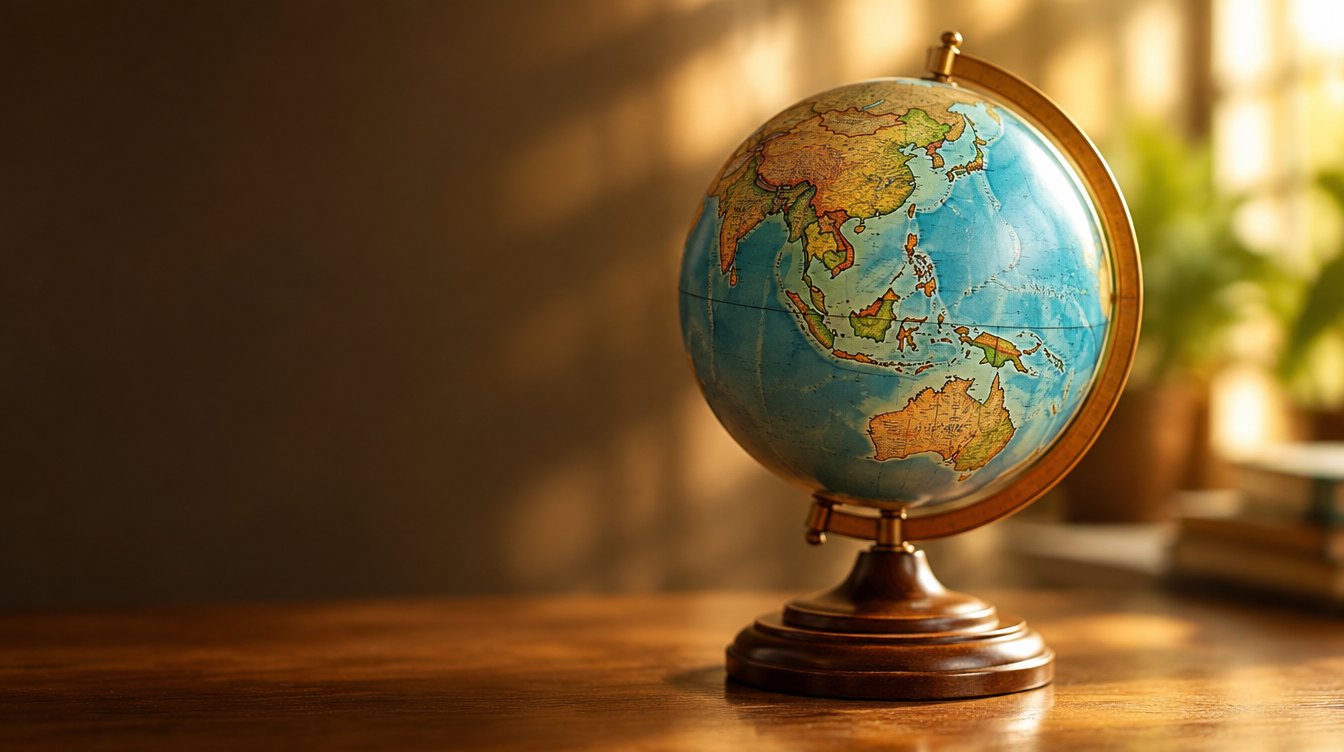
Thailand lies in the centre of mainland Southeast Asia. The country stretches from the foothills of the Himalayas in the north to the middle of the Malay Peninsula in the south, between latitudes 5°37′ and 20°27′ North. It is entirely in the Northern Hemisphere and entirely in the tropics (Geography of Thailand, Wikipedia).
Key figures:
- Area: 513,120 km², slightly larger than Spain.
- Land borders: 4,863 km in total.
- Highest point: Doi Inthanon in the north, 2,565 m.
- Capital: Bangkok, on the Chao Phraya River near the top of the Gulf of Thailand.
- Time zone: UTC+7 all year, no daylight saving.
On a world map, look south of China, east of India and Myanmar, and north-west of Indonesia. Singapore is about 1,400 km south of Bangkok in a straight line.
Neighbouring countries and land borders
Thailand has four land neighbours (Wikipedia):
- Myanmar (Burma) to the west and north-west. The longest border, running through mountains and forest. For someone based in Pattaya or Phuket it matters mostly as history and culture.
- Laos to the north and north-east. For about 920 km the Mekong River forms the border. River crossings and bridges connect the two countries in the north-east and in Chiang Rai province.
- Cambodia to the east and south-east, across hills and plains. Check the current status of land crossings before planning an overland trip, as they can close at short notice.
- Malaysia to the south. Southern Thailand is the only land route from mainland Asia to Malaysia and Singapore.
Most Western visitors arrive by air, so land borders rarely matter. If you plan overland trips into neighbouring countries, note that visa-exempt entries into Thailand over a land border are limited to two per calendar year for most nationalities (TAT, September 2026).
Two coasts: the Gulf of Thailand and the Andaman Sea
Thailand has two separate coastlines, and they have different weather calendars.
- The Gulf of Thailand (an arm of the South China Sea) washes the east and the east side of the southern peninsula. Here you find Pattaya, Jomtien, Bang Saray, Rayong, Hua Hin, Koh Samui, Koh Phangan and Koh Tao. Around 70% of the Gulf’s coastline belongs to Thailand. The sea is generally calmer than on the west coast.
- The Andaman Sea (part of the Indian Ocean) washes the west coast of the peninsula: Phuket, Krabi, the Phi Phi Islands, Koh Lanta, Koh Lipe and the Similan Islands. Limestone cliffs, islands and good diving are typical. The best beach weather is roughly November to April; from May to October the south-west monsoon brings rain and rougher seas.
If your trip falls in the Andaman rainy season, the Gulf coast is often the better choice, and the reverse is true for the Gulf islands in late autumn.
Thailand’s regions and what each one offers
Northern Thailand: mountains, temples and a cooler winter
The north is mountainous, with no beaches, many temples and a noticeably cooler and drier winter. Chiang Mai, the main city, has an old town ringed by a moat and walls and is popular with long-stay visitors. Trekking, hill villages, national parks and ethical elephant sanctuaries are the main draws. Chiang Rai, further north, is known for the White Temple (Wat Rong Khun) and the Black House (Baan Dam). Nights from November to February can be genuinely cool.
- Suits: people interested in culture and nature, and anyone who wants a cooler winter.
- Property: mainly houses and condos in and around Chiang Mai; prices are generally lower than at the big beach resorts.
Central Thailand: Bangkok and the gateway to the country
Bangkok is the political and economic centre and the main international entry point. Skyscrapers, temples (the Grand Palace, Wat Pho, Wat Arun), markets, malls and an extensive rail network sit side by side. The climate is hot and humid all year, with rain mainly from May to October.
- Suits: city life, business, shopping, and easy connections to the rest of Thailand and the region.
- Property: a very large condominium market at every price level, with location and building class driving prices.
The Eastern Seaboard: Pattaya, Jomtien and nearby coast
Pattaya sits on the east side of the Gulf of Thailand in Chonburi province, about 150 km from Bangkok by road. It is one of Thailand’s oldest resorts and today a full city with hospitals, international schools, malls and a wide range of restaurants. Beyond the nightlife reputation there are quieter districts: Jomtien and Na Jomtien to the south, Pratamnak hill between Pattaya and Jomtien, Wongamat and Naklua to the north, and residential East Pattaya with many houses and villas. Koh Larn island is a short boat ride away for day trips.
- Suits: people who want a beach city close to Bangkok and its airports, with established services for foreign residents.
- Property: an active market of condominiums and villas, both in central tourist areas and quieter neighbourhoods, generally more affordable than Phuket.
Southern Thailand: the Andaman coast and the Gulf islands
Phuket is Thailand’s largest island, with everything from busy Patong and Karon to quiet bays and villa areas. Krabi province (Ao Nang, Railay and the gateway to Phi Phi) is known for cliffs and islands and attracts climbers, kayakers and divers. Further south, Koh Lanta and Koh Lipe are calmer. The Similan Islands are a well-known dive area open only part of the year.
On the Gulf side, Koh Samui, Koh Phangan and Koh Tao follow a different weather pattern: their wettest period is late in the year, typically October to December, and the drier months are around January to April.
- Suits: beach life, diving and island living.
- Property: condominiums and sea-view villas; Phuket and Samui are popular with investors.
Comparison of Thailand’s regions
| Region | Key places | Character | Climate | Most comfortable months | Typical property |
|---|---|---|---|---|---|
| North | Chiang Mai, Chiang Rai | Mountains, temples, culture, trekking | Cooler and drier in winter | November - February | Houses and condos, generally lower prices |
| Central | Bangkok | Capital, business, shopping, transport hub | Hot and humid, rain May - October | November - February | Large condo market, all price levels |
| East coast | Pattaya, Jomtien, Rayong | Beach city, services, close to Bangkok | Hot and humid, rain May - October | November - February | Condominiums and villas, active market |
| South, Andaman | Phuket, Krabi, Phi Phi | Beaches, islands, diving | Dry November - April, rainy May - October | December - March | Condos, sea-view villas |
| South, Gulf | Samui, Phangan, Tao | Island life, diving | Wettest October - December | January - April | Condos and villas |
How far is Thailand from the UK, Europe, the US and Australia
Straight-line (great-circle) distances from central Bangkok, calculated from city coordinates. Actual flight routes are somewhat longer.
| From | Distance to Bangkok |
|---|---|
| London | about 9,500 km (5,900 miles) |
| Dublin | about 9,900 km (6,100 miles) |
| Berlin | about 8,600 km (5,300 miles) |
| Moscow | about 7,100 km (4,400 miles) |
| Dubai | about 4,900 km (3,000 miles) |
| New York | about 13,900 km (8,700 miles) |
| Toronto | about 13,600 km (8,500 miles) |
| Los Angeles | about 13,300 km (8,300 miles) |
| Sydney | about 7,500 km (4,700 miles) |
| Melbourne | about 7,400 km (4,600 miles) |
| Perth | about 5,300 km (3,300 miles) |
| Auckland | about 9,600 km (5,900 miles) |
| Singapore | about 1,400 km (900 miles) |
Flights to Thailand: nonstop routes and connections
The schedules below are taken from published airline timetables for the 2026-2027 season (FlightsFrom.com: London, Frankfurt, Helsinki, Sydney, Melbourne, Perth). Airlines change routes, so check before booking.
From the UK and Ireland
- London Heathrow - Bangkok: nonstop with Thai Airways (twice daily) and EVA Air (daily), about 11.5-12 hours.
- London Gatwick - Bangkok: British Airways, and seasonally Norse Atlantic (AirlineGeeks).
- London Heathrow - Phuket: Virgin Atlantic announced a seasonal nonstop service three times a week from 18 October 2026 (AirlineGeeks, Nov 2025).
- From Dublin and UK regional airports, travellers usually connect via London, a continental European hub or a Gulf hub.
From continental Europe
- Frankfurt - Bangkok: Thai Airways (twice daily) and Condor, about 10.5-11.5 hours.
- Helsinki - Bangkok: Finnair, about 11 hours.
- Other cities connect via these hubs, via Gulf carriers through Dubai, Doha or Abu Dhabi, or via Istanbul.
From the US and Canada
There are no nonstop flights between North America and Thailand at present. Usual options are one stop via East Asian hubs (Tokyo, Seoul, Taipei, Hong Kong), via the Gulf, or via Europe. Plan for a long travel day and a big time shift: Bangkok is 11-12 hours ahead of New York and 14-15 hours ahead of Los Angeles.
From Australia and New Zealand
- Sydney - Bangkok: Thai Airways (twice daily) and Qantas (daily), about 9.5-10 hours.
- Melbourne - Bangkok: Thai Airways (twice daily) and Jetstar, about 9-9.5 hours. Finnair is scheduled to add a Melbourne - Bangkok sector from late October 2026.
- Perth - Bangkok: Thai Airways and Jetstar, about 7 hours.
- From New Zealand, most travellers connect via Australia or an Asian hub.
Thailand’s main international airports
Suvarnabhumi (BKK), Bangkok
Bangkok’s main international airport and the country’s largest, about 30 km east of central Bangkok. It opened in 2006. The Airport Rail Link runs into the city; taxis and buses are also available. Pattaya is reached by road, usually in about two hours depending on traffic. Bangkok’s second airport, Don Mueang (DMK), is used mostly by low-cost airlines.
Phuket (HKT)
The main airport for the Andaman coast, in the north of the island, about 30 km from Phuket Town. Beaches such as Nai Yang and Mai Khao are close; Patong, Kata and Kamala are roughly 40 minutes to an hour away by road.
U-Tapao (UTP), near Pattaya
Also called U-Tapao Rayong-Pattaya International Airport, it is the closest airport to Pattaya, roughly 40-50 minutes by road. It has far fewer flights than Suvarnabhumi, mostly domestic and some regional international routes, but it is worth checking if your connection allows it.
Chiang Mai (CNX)
The main airport of the north, close to the old city. Domestic flights from Bangkok are frequent, and there are some international regional routes. Chiang Rai (CEI) serves the far north.
Koh Samui (USM), Krabi (KBV) and Surat Thani (URT)
Samui’s small, open-air airport is privately run by Bangkok Airways and is served mainly from Bangkok; tickets tend to cost more than to Phuket. Krabi airport serves Ao Nang, Railay and the islands. Surat Thani is the cheaper alternative for the Gulf islands, with ferries onwards to Samui, Phangan and Tao.
Entry rules for Western travellers since 15 September 2026
Thailand changed its visa exemption rules in September 2026:
- 30-day visa exemption. Since 15 September 2026 the former 60-day exemption has been repealed. Nationals of 60 countries and territories, including the UK, Ireland, the US, Canada, Australia, New Zealand, Germany, France, the Netherlands, the Nordic countries, Switzerland and most other EU states, can enter visa-free for up to 30 days for tourism (TAT, September 2026). Anyone who arrived before 15 September keeps the period stamped on entry.
- Extension. The 30-day stay can be extended once by up to 30 days at an immigration office, at the officer’s discretion (Royal Thai Embassy, Washington DC). The standard fee is 1,900 THB (form TM.7).
- Land borders. Visa-exempt entries over land are limited to two per calendar year for most nationalities.
- TDAC. All foreigners must complete the free Thailand Digital Arrival Card before arrival, on the official site tdac.immigration.go.th (mandatory since 1 May 2025). Use only the official site.
- Proof of funds. Officers may ask for evidence of funds on arrival; checks are selective. The Washington embassy page cites 20,000 THB per person or 40,000 THB per family for visa-exempt travellers, and TAT’s July 2026 reminder lists amounts by entry type (TAT, July 2026).
- Longer stays. A Tourist Visa gives 60 days plus one 30-day extension. For remote workers and long stays, the Destination Thailand Visa (DTV) is a five-year multiple-entry visa allowing up to 180 days per entry, extendable once per entry; since 31 August 2026 you apply through the Thai mission for your country of nationality or residence, and a police clearance certificate is required (Royal Thai Embassy, London). Applications go through thaievisa.go.th.
- Overstay is fined at 500 THB per day.
Rules change often. Check the official sources above shortly before you travel.
Climate and seasons across Thailand
Thailand is tropical: hot and humid most of the year. But the seasons differ by region.
Bangkok, the centre and the north
- Hot season (March - May): the hottest months, with daytime temperatures often in the mid to high 30s °C and warm nights.
- Rainy season (June - October): heavy but usually short downpours, high humidity, lower hotel prices and green landscapes.
- Cool season (November - February): the most comfortable months, drier and less humid. In Chiang Mai nights can be quite cool. This is also peak season, with higher prices.
The Andaman coast: Phuket and Krabi
- Dry season (November - April): stable weather, calm seas, ideal for beaches, diving and boat trips. Peak prices.
- Rainy season (May - October): more changeable weather, rougher seas on west-facing beaches, good for surfing and noticeably lower prices.
The Gulf islands: Samui, Phangan and Tao
- Drier months: roughly January to April, with calm seas.
- Wettest period: typically October to December, when prolonged rain and storms are possible.
- The middle of the year is often fairly settled on these islands, when the Andaman coast is at its wettest.
Pattaya and the east coast
Pattaya follows the central pattern: rain mainly from May to October, the most comfortable weather from November to February and the hottest months from March to May.
Choosing when to go
- Phuket or Krabi with calm seas: November to April.
- Bangkok, Chiang Mai or Pattaya in comfortable temperatures: November to February.
- Lower prices and fewer people: the rainy season, if short tropical downpours do not bother you.
- Samui or Koh Tao during the European summer: generally a good fit, as the Gulf islands are often drier then than the Andaman coast.
Questions and answers about Thailand’s location
Where is Thailand on the world map? In mainland Southeast Asia, south of China and east of Myanmar, with coastlines on the Gulf of Thailand and the Andaman Sea. It lies entirely north of the equator, between about 5° and 20° North.
Which countries border Thailand? Four: Myanmar to the west and north-west, Laos to the north and north-east, Cambodia to the east and south-east, and Malaysia to the south.
How far is Thailand from the UK? About 9,500 km in a straight line from London to Bangkok. Nonstop flights from Heathrow take about 11.5-12 hours.
How far is Thailand from the US? About 13,900 km from New York and 13,300 km from Los Angeles in a straight line. There are no nonstop flights at present, so expect at least one connection.
How far is Thailand from Australia? About 7,500 km from Sydney, 7,400 km from Melbourne and 5,300 km from Perth. Nonstop flights take roughly 9.5-10 hours from Sydney and about 7 hours from Perth.
How far is Pattaya from Bangkok? About 150 km by road, usually around two hours from Suvarnabhumi Airport depending on traffic.
Do I need a visa for Thailand? Citizens of the UK, Ireland, the US, Canada, Australia, New Zealand and most EU countries can enter visa-free for up to 30 days for tourism since 15 September 2026, extendable once by up to 30 days. Everyone must complete the free TDAC before arrival.
Once Thailand is no longer just a point on the map but a place you are considering for a home, MontMari can help you compare areas and properties. Browse apartments and condos and villas in Pattaya and on Phuket, or contact us to discuss what you are looking for.
More articles