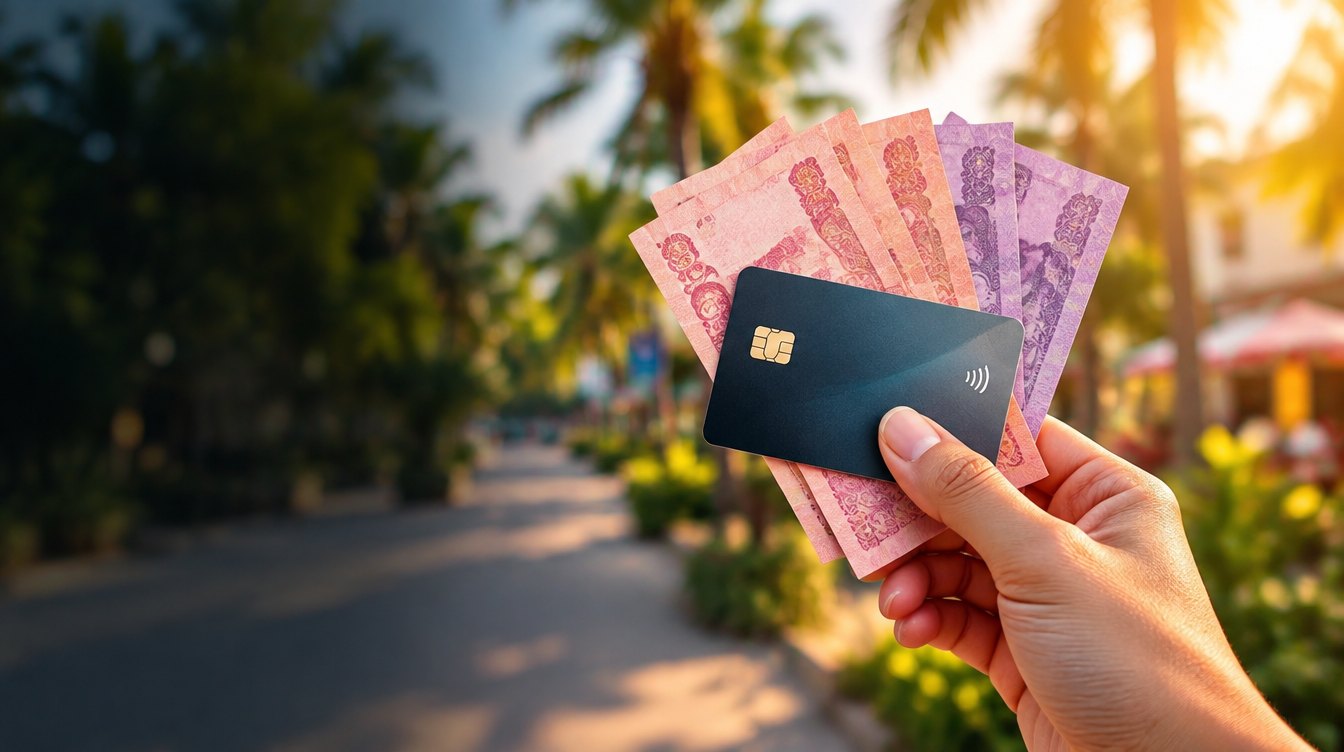

Most guides to money in Thailand still say that every ATM withdrawal with a foreign card costs 220 baht. That was true for years, but it is no longer the case at the banks whose current fee schedules we checked. Below is what paying and getting cash in Thailand costs in 2026 for someone arriving from the UK, Europe, the US or Australia: cards, ATMs, Wise and Revolut, cash exchange in Pattaya and at Suvarnabhumi, and the customs rules for carrying cash.
All figures were checked on official bank, exchanger and government pages on 1 October 2026. Fees and rates change, so treat them as a snapshot and check the source link before a large transaction.
Where Visa and Mastercard work in Thailand and where you need cash
In Pattaya and Bangkok, shopping malls, supermarket chains, hotels, larger restaurants and international chains generally accept Visa and Mastercard. Smaller places are different. Street food stalls, markets, motorbike taxis, small family restaurants and many small shops take cash or a Thai QR code, not cards.
That QR code is PromptPay (Thai QR Payment), the national instant payment system. Thais pay almost everything by scanning it from a banking app. Without a Thai bank account you normally cannot use it, which is why visitors end up carrying more cash than locals do.
There are two ways for visitors to pay by Thai QR that we could confirm on official sources:
- TAGTHAi Easy Pay with the KBank PAY&TOUR card. Kasikornbank and the Tourism Authority of Thailand launched it on 17 March 2025: a prepaid PAY&TOUR card that tourists get at KBank exchange booths (including at Suvarnabhumi) with a passport, linked to the TAGTHAi app, which can then scan and pay Thai QR codes, according to the Kasikornbank announcement. KBank’s fee schedule effective 22 September 2026 lists a 150 baht joining fee for the PAY&TOUR card (a free-joining promotion ran until 22 July 2026), 20 baht per cardless ATM withdrawal from the tourist wallet, and a promotion waiving that ATM fee from 22 July to 31 December 2026.
- GrabPay for Travel. In April 2026 Grab announced a feature that lets you scan local national QR codes with the Grab app using your home credit or debit card, with a convenience fee shown before you confirm. Grab said it would reach Thailand “by the end of the year”, so check in the app whether it is live when you arrive.
For rides and food delivery, the Grab app lets you add a card and pay inside the app, which covers a good share of everyday spending for many newcomers.
Thai ATM fees for foreign cards in 2026: 250 THB for Visa, 350 THB for Mastercard
When you withdraw cash in Thailand with a card issued abroad, the Thai bank that owns the ATM charges a flat fee per withdrawal. For years it was 220 baht. The current official fee schedules we found show higher amounts and, for the first time, a different price for Visa and Mastercard:
| Bank (ATM owner) | Visa | Mastercard | UnionPay | In force since | Source |
|---|---|---|---|---|---|
| Kasikornbank (KBank) | 250 THB | 350 THB | 250 THB | schedule effective 22 Sep 2026 | KBank fee announcement |
| Krungsri (Bank of Ayudhya) | 250 THB | 350 THB | 250 THB | 11 Mar 2026 | Krungsri fee announcement |
For Bangkok Bank, SCB and Krungthai we could not find a current published fee for foreign cards on their official sites, so we do not quote a figure. The ATM screen shows the fee before you confirm the withdrawal: read it, and if it is higher than you expect, cancel and try another bank’s machine.
What this means in practice:
- The fee is per withdrawal, not per day. Two withdrawals of 10,000 baht with a Mastercard cost 700 baht in ATM fees; one withdrawal of 20,000 baht costs 350.
- Visa is cheaper than Mastercard at Thai ATMs at the two banks above: 250 against 350 baht. If you carry both, use the Visa card for cash.
- Per-withdrawal limits are not listed in these fee schedules. The machine shows the maximum it will dispense; withdrawing close to that maximum each time keeps the flat fee small as a percentage.
- Your home bank charges on top. Many banks add a foreign transaction fee (a percentage of the amount) and sometimes a fixed fee for using a foreign ATM. Check your own card’s tariff before you travel; this is often the bigger cost.
Dynamic currency conversion: always choose to be charged in Thai baht
Dynamic currency conversion (DCC) is when an ATM or card terminal offers to charge you in your home currency instead of baht. The screen typically shows the amount in your home currency next to the amount in baht, or asks whether you want to “accept conversion”, sometimes with the home currency option highlighted. If you accept, the ATM operator or merchant sets the exchange rate, and it includes their margin.
Visa’s own guidance says merchants and ATMs must give you the choice, must not choose for you, and must show the exchange rate and any markup; if you feel pressured, Visa suggests declining the conversion and reporting it to your card issuer.
The practical rule is simple: at ATMs and card terminals, always choose THB (baht), “without conversion” or “decline conversion”. Your card network and your bank (or Wise or Revolut) then do the conversion. In restaurants, check the slip before you sign or tap: if it shows your home currency, ask the staff to run it again in baht.
Wise and Revolut cards in Thailand: free ATM allowances and fees by country
Wise and Revolut cards work wherever Visa or Mastercard is accepted. Wise says it converts at the mid-market rate with a conversion fee shown in the app; Revolut uses its own exchange rate plus any fee shown in the app. For many people this is cheaper than a traditional bank card with a foreign transaction fee. Two things to keep in mind: the Thai ATM fee above still applies on top, and each provider’s free ATM allowance depends on the country where your account is held and, for Revolut, on your plan.
Wise (personal card pricing pages checked 1 October 2026):
| Account country | Free ATM withdrawals per month | Fee above the allowance | Source |
|---|---|---|---|
| United Kingdom | up to 250 GBP | 2.69% of the amount over 250 GBP | wise.com/gb |
| Ireland | up to 250 EUR | 2.69% of the amount over 250 EUR | wise.com/ie |
| United States | up to 250 USD | 1.95 USD + 1.95% per withdrawal after 250 USD | wise.com/us |
| Australia | up to 400 AUD | 2.69% of the amount over 400 AUD | wise.com/au |
All Wise pages add that ATM operators may charge their own fees, which in Thailand means the 250 or 350 baht above.
Revolut (UK Standard plan, fees page updated 11 December 2025): free ATM withdrawals up to 5 withdrawals or 200 GBP per rolling month, whichever comes first, then 2% per withdrawal with a minimum of 1 GBP. Currency exchange on the Standard plan is subject to a fair usage limit of 1,000 GBP per month, above which a 1% fee applies; Plus has a 3,000 GBP limit with 0.5%, and Premium, Metal and Ultra have no limit. Other countries and plans have different numbers, so check the fees page for your own account.
Getting baht into a Thai bank account. Wise can send money to Thai bank accounts in THB. Wise explains on its Thailand transfer page that it pays out through local Thai partner banks, so the transfer does not arrive as an international transfer, and Wise cannot issue a Confirmation Letter of International Fund Transfer. For living costs that does not matter. For buying a condominium it does: the Land Department needs proof that the purchase money came from abroad in foreign currency. We cover this in detail in our guide on how to transfer money to buy real estate in Thailand.
Exchanging US dollars, euros and pounds: SuperRich, T.T. Exchange and banknote size
Bringing cash and exchanging it at a licensed money changer is still a common way to get baht, especially for larger sums. The best-known names:
SuperRich: two separate companies. There are two exchange businesses with the SuperRich name. Super Rich (Thailand) Co., Ltd. uses a green logo, and its website refers to the “Superrich Green Group” (superrichthailand.com). SuperRich Currency Exchange (1965) Co., Ltd. uses an orange logo and runs a separate network (superrich1965.com). They are not the same firm, so check the branch list of the one you plan to visit.
SuperRich Thailand (green) lists these branches relevant to Pattaya and the Eastern Seaboard on its locations page (checked 1 October 2026):
- Central Pattaya, 1st floor near the Hilton hotel lobby, open daily 11:00-20:00.
- Central Chonburi and Central Si Racha shopping malls.
- Suvarnabhumi Airport, B floor (Airport Rail Link), open daily 05:00-23:30.
According to its FAQ, SuperRich Thailand charges no commission or fees, requires a valid (not expired) passport or ID card, and does not exchange coins.
T.T. Currency Exchange in Pattaya. A local chain with branches across Pattaya, including Naklua (head office), Central and South Pattaya, Walking Street, Royal Garden Plaza and Jomtien. Its FAQ states no commissions or fees, the same rates at all branches, no coins, and that you need a passport (expired documents are not accepted). Rates are published live on ttexchange.com.
Large notes get better rates. Both exchangers publish separate rates by banknote size. On 1 October 2026 SuperRich Thailand’s headquarters board showed 33.55 baht per dollar for 100 and 50 USD notes, but 33.49 for 20 and 10 USD notes and 33.29 for 1 USD notes (superrichthailand.com). T.T. Exchange lists USD, EUR and GBP in separate large, medium and small note categories. If you bring dollars, bring 100 or 50 USD notes. Neither exchanger publishes a written policy on old or damaged notes, so bring clean, undamaged banknotes and ask before exchanging anything worn or of an older series.
Compare before you exchange. SuperRich and T.T. Exchange both publish their rates online, and Thai banks publish theirs on their websites. Check on the day, since rates move during the day.
Exchanging money at Suvarnabhumi Airport: arrivals hall or Airport Rail Link level
Several bank exchange booths operate in the Suvarnabhumi arrivals area. If you do not need baht urgently, compare their board rate with the rate SuperRich publishes online: SuperRich Thailand’s airport branch is one floor down from arrivals, on the B floor next to the Airport Rail Link station, open 05:00-23:30 every day, and it sells and buys the main currencies including USD, GBP, EUR, AUD, CHF, CAD, NZD and the Scandinavian currencies (SuperRich locations page).
A sensible approach for a first trip: exchange or withdraw a modest amount for the taxi and the first day, then exchange the rest in town where you can compare rates calmly. If you plan to use TAGTHAi Easy Pay, KBank’s exchange booths at the airport are where the PAY&TOUR card is issued, according to Kasikornbank.
How much cash you can bring into Thailand: the USD 20,000 declaration rule
You can bring foreign currency into or out of Thailand without an upper limit, but if the total exceeds USD 20,000 or its equivalent, you must declare it to a Customs officer on arrival or departure. Failing to declare, or making a false declaration, is a criminal offence. Source: the Royal Thai Embassy in Singapore, quoting the Thai Customs Department (page dated 13 February 2023). The threshold applies to the aggregate amount, so cash in several currencies counts together.
For Thai baht leaving the country, the same page states a limit of 500,000 baht when travelling to countries bordering Thailand and 50,000 baht to any other destination; above that you must declare or exchange the money before departure. If you are unsure, the Thai Customs hotline is 1164 and the official site is customs.go.th.
Remember also that immigration may ask visa-exempt travellers for proof of funds on arrival; checks are selective. See our TDAC and arrival guide for current entry formalities.
Opening a Thai bank account as a foreigner: what banks ask for
A Thai account gives you PromptPay QR payments, free withdrawals from your own bank’s ATMs and an easy way to pay rent and utility bills. It is not available to everyone.
Kasikornbank’s savings account page (checked 1 October 2026) lists for foreigners: a passport, a Non-Immigrant visa (any type), a government-issued ID from your home country (such as a national ID card or driving licence), and documents matching the purpose of your stay, such as a work permit or a university or school certificate. It also states plainly that accounts are not opened for holders of tourist visas or other travel-type permissions, including visa exemption, Visa on Arrival and the Destination Thailand Visa (DTV), and that the bank may ask for additional documents.
Other banks set their own rules, and in practice requirements can differ between branches of the same bank. Go with your passport, your visa and proof of your Thai address (for example a rental contract), and ask the branch what else it needs before you go. If you are buying a condominium, the bank account usually becomes part of the purchase process, and MontMari can advise on the sequence.
Summary table: the cheapest way to get baht and pay in Thailand
| Method | Typical cost (sources above, checked 1 Oct 2026) | When to use it |
|---|---|---|
| Visa or Mastercard in shops, malls, hotels, Grab | Your bank’s foreign transaction fee, if any; nothing if you pay in THB with Wise or Revolut within plan limits | Everyday spending where cards are accepted; always pay in THB |
| ATM with a foreign card | 250 THB (Visa) or 350 THB (Mastercard) per withdrawal at KBank and Krungsri, plus your bank’s fees | When you need cash; withdraw larger amounts less often, use Visa if you can |
| Wise card at an ATM | Thai ATM fee plus Wise’s fee above the monthly free allowance (e.g. 250 GBP, 250 EUR, 250 USD or 400 AUD) | Cash for daily life without high bank FX margins |
| Revolut card at an ATM | Thai ATM fee plus Revolut’s fee above the plan allowance (UK Standard: 5 withdrawals or 200 GBP per month) | Same as Wise; check your country and plan |
| Cash USD, EUR or GBP at SuperRich or T.T. Exchange | No commission; rate depends on note size (100 and 50 USD best) | Larger sums, short stays, when you want no ATM fees |
| TAGTHAi Easy Pay (KBank PAY&TOUR) | 150 THB joining fee per KBank schedule; cardless ATM 20 THB (waived to 31 Dec 2026) | Paying Thai QR codes at stalls and small shops without a Thai account |
| Thai bank account | Local fees only; PromptPay transfers | Long stays with a Non-Immigrant visa, paying rent and bills |
| Bank transfer for a property purchase | Depends on your bank and route | Buying a condominium: needs proof that money came from abroad in foreign currency |
Short checklist before you fly
- Carry at least one Visa card for ATM withdrawals and tell your bank you are travelling.
- Know your home bank’s foreign transaction and ATM fees, or use Wise or Revolut within your free allowance.
- At every ATM and card terminal, choose THB and decline conversion.
- Bring clean 100 or 50 USD notes (or large EUR and GBP notes) if you plan to exchange cash, and your passport.
- Declare cash above USD 20,000 or its equivalent at customs.
- If you are planning to buy property, read our guide on transferring money for a property purchase before you move any money, and see the condominiums currently available in Pattaya.
More articles