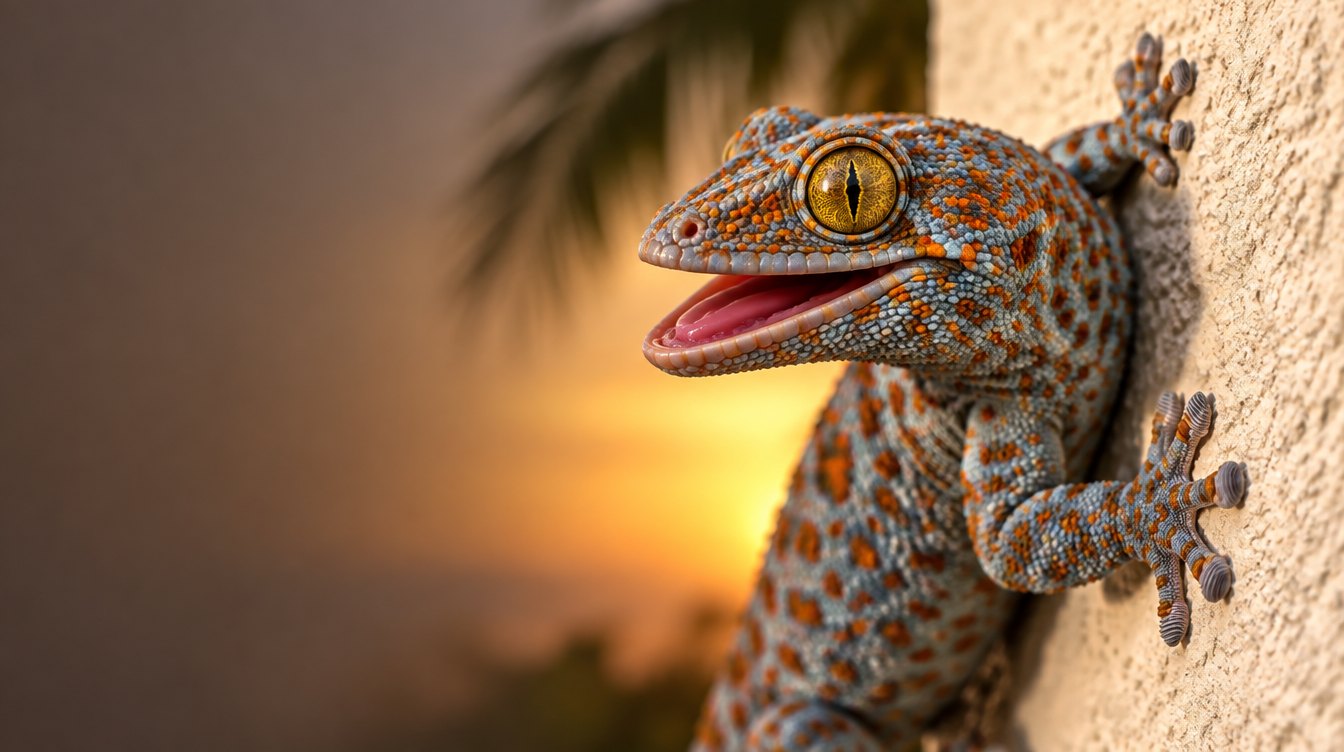

The first night in Pattaya goes the same way for almost everyone. Somewhere above your head comes a loud, clear “to-KAY!”, then again, and another eight times in a row. In the morning a bird takes over, asking the same question higher and higher until its voice breaks. During the day an even electric hum switches on that is easy to mistake for a faulty transformer. And after the first heavy rain, a cow starts mooing in the bushes below, where no cow could possibly be.
Articles about Thailand usually spell these sounds out in letters: “to-kee”, “ek-ek-ek”. You can read that, but you cannot identify anything by it. So instead of descriptions, this page has the recordings themselves: the calls of fifteen animals, each behind a play button. Press it, listen, compare with what you heard.
The second half of the article is about which Thai wildlife is actually worth worrying about. A spoiler worth knowing in advance: the loudest things here are harmless, and the truly dangerous ones are almost always silent.
1-minute quiz
Guess who is calling in Thailand
Five recordings of real animal calls. Listen, pick one of four answers and get a title at the end - from “Fresh off the plane” to “Thai tracker”.
Your title
Link with your result copied
A calm Thai night: sounds for sleep
But let us start with the pleasant part. A quiet night in Pattaya can sound like this: the rustle of rain in the rainy season, the surf if you live by the sea, and an even chirping from the nearest trees. These three recordings loop until you press them again, so you can leave them on as background noise for sleep.
a steady rustle, no thunder
A familiar night sound of the rainy season and a good background for sleep: steady, without sudden peaks. The recording is long and loops until you press it again.
steady rolling waves
This is how a night by the sea sounds in a quiet spot if you open the balcony door. Loops.
an even tick-tick-tick, like a metronome
Not all cicadas are deafening like the ones in the card below: this species chirps in even, soft pulses, almost like a metronome. Loops.
“I hear this” table: where to start
If you came here with a specific question, start here. The left column is what you heard, the right column links to the card with the recording.
| What you hear and when | Who it is |
|---|---|
| At night. A loud, abrupt “to-KAY!” 5-10 times in a row | Tokay gecko |
| Evening and night. A quiet, dry “chik-chik-chik” from behind the wardrobe | House gecko |
| At night after rain. A low mooing, as if a cow were in the bushes | Banded bullfrog |
| From 4-5 a.m. A loud “ko-EL?” rising higher and higher until it breaks | Asian koel |
| Early morning. A hollow, even “oop-oop-oop-oop” with no rise in pitch | Greater coucal |
| All day. A metallic knock once a second, like a metronome | Coppersmith barbet |
| Daytime, especially at sunset. An even hum in waves, very loud | Cicadas |
| All day. Soft cooing in three syllables | Spotted dove |
| All day. Creaks, clicks, sometimes snippets of borrowed sounds | Common myna |
| Dawn and dusk. A long, beautiful song, different every time | Oriental magpie-robin |
| Morning and daytime. A cheerful “pree-vee-veet!” in short phrases | Red-whiskered bulbul |
| Morning. A clean, fluting “tyoo-leeoo” whistle | Black-naped oriole |
| Morning, forest only. An accelerating howl in chorus, heard for kilometres | Pileated gibbon |
| Daytime, forest only. A harsh, barking “kek-kek-kek” plus the noise of wings | Oriental pied hornbill |
| Daytime, forest only. A flock suddenly bursts out laughing | White-crested laughingthrush |
Night sounds: the tokay gecko, the house gecko and the frog that moos after rain
At night in town only a handful of sources make noise, and all of them are harmless. Let us start with the main one.
Tokay gecko - the call that keeps you awake
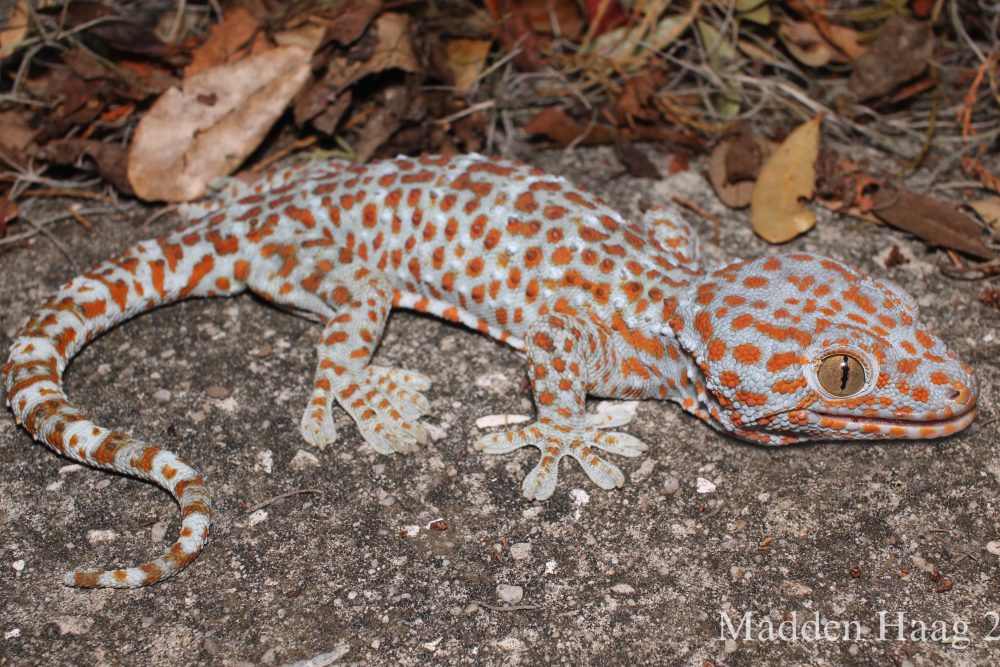
to-KAY!… to-KAY!… to-KAY!
The loudest and most startling sound of a Thai night. Loud, abrupt calls, 5-10 in a row with a pause between them. The Thai name is the call itself: no bird does this - it is a lizard the size of your palm.
Photo: MH Herpetology, CC BY-SA 4.0
This is a lizard about the length of your palm, blue-grey with orange spots, living in wall cracks and under roofs. Its Thai name, ตุ๊กแก (tuk-kae), is pure onomatopoeia: what you hear is its name. It is the male that calls, marking territory and attracting a female, so it is loudest in the breeding season.
The tokay is not dangerous to people. The only way to get hurt is to grab one: its grip is strong, and the bite is painful and can break the skin. Do not pick it up and there is nothing else to worry about.
House gecko, or jing-jok - small and useful
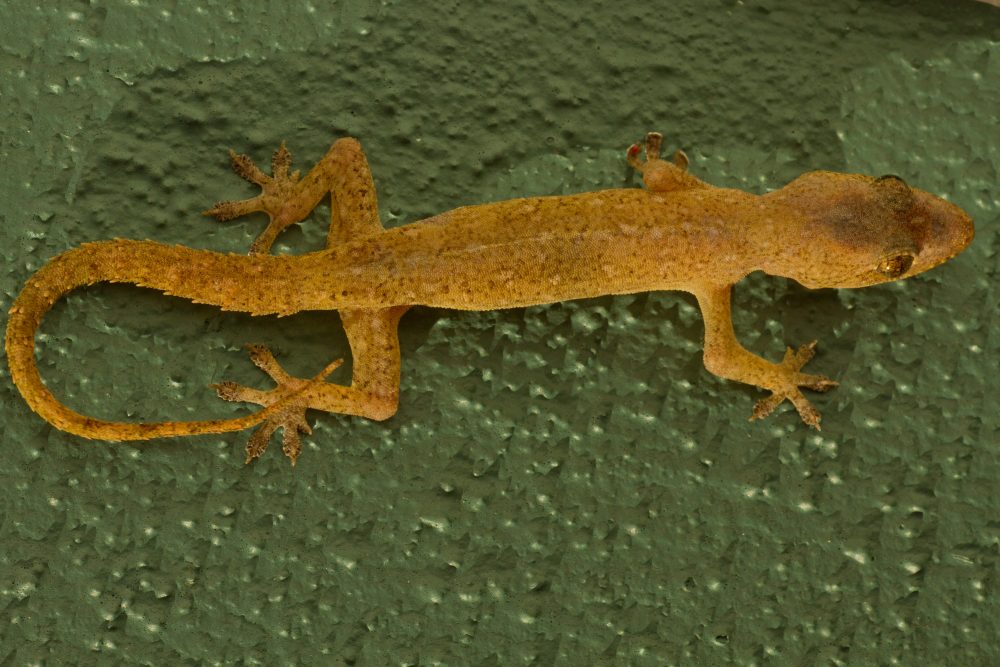
chik-chik-chik-chik
The small pale gecko on your ceiling that eats mosquitoes. A quiet, dry call in short series. A soft “chik-chik” from behind the wardrobe is this one, not the tokay.
Photo: Andrew Mercer, CC BY-SA 4.0
The pale little gecko, about ten centimetres long, that runs across the ceiling near the lamp. It eats mosquitoes and midges, so it works for you for free. Its voice is quiet and dry, in short series. If a soft “chik-chik-chik” comes from behind the wardrobe, it is the house gecko, not the tokay: the difference in volume is tenfold, so they are hard to confuse.
The frog that moos only after rain
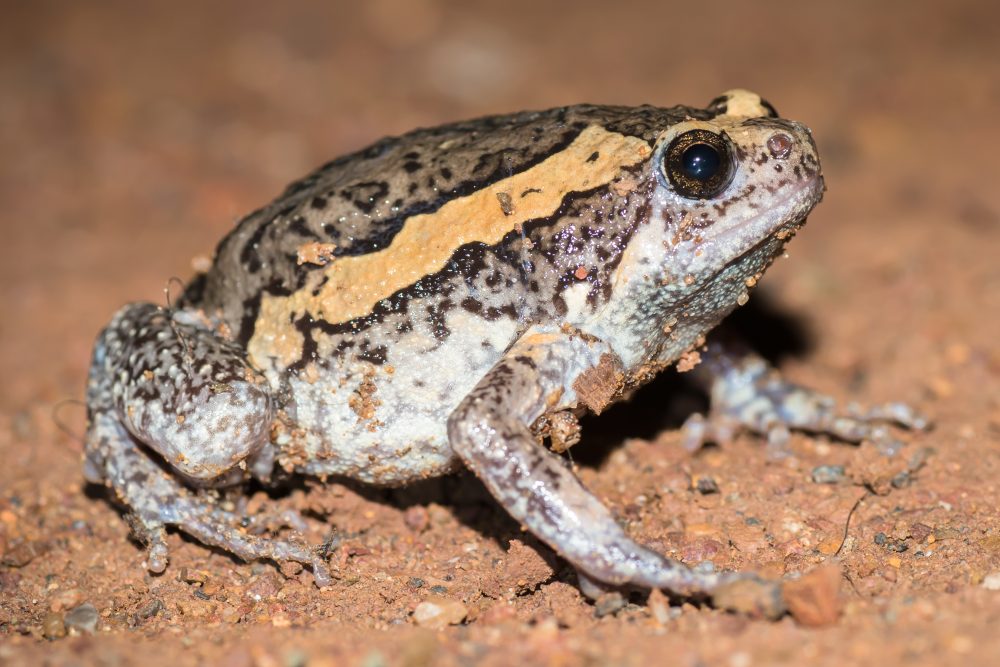
mooo… mooo…
People regularly mistake it for a cow or a faulty alarm. A low, drawn-out drone, always in chorus and always after rain. If the sound is gone a day later, it was definitely this frog.
Photographed in Thailand, Phetchabun province.
Photo: Rushen, CC BY-SA 2.0
The most underrated mystery of the Thai night. People seriously go looking for a cow, a faulty alarm or a humming pump. In fact it is the banded bullfrog - stocky, brown, the size of a fist. It spends most of the year underground, and after heavy rain it comes out and sings in chorus, low and drawn out.
The diagnostic sign is reliable: the sound appears on the night after rain and disappears within a day or two. If the hum has been going on for three weeks without a break, it is not a frog, it is machinery.
At dawn and during the day: what bird screams “ko-el” and who knocks like a hammer
Asian koel - the main reason for lost sleep
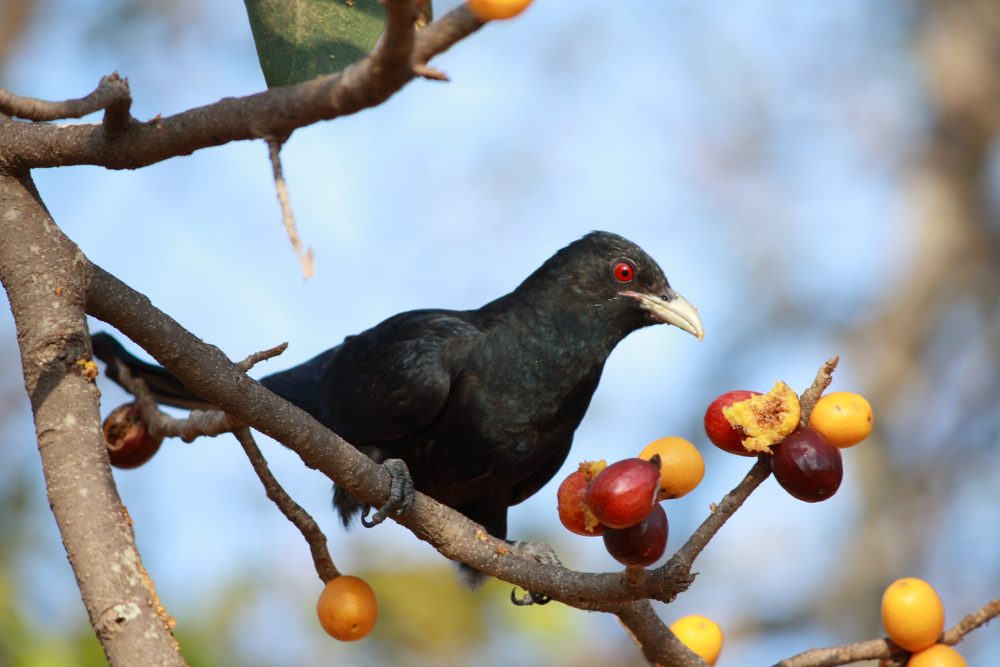
ko-EL?… ko-EL?… ko-EL?! - higher each time
The main answer to “what bird keeps screaming in the morning?”. A two-note questioning call that repeats and rises in pitch until it breaks. The male is black with a red eye, the female brown and speckled. Nothing like a European cuckoo.
This is the male. The female looks completely different - brown and covered in pale speckles.
Photo: Primejyothi, CC BY-SA 3.0
If you were searching for what bird screams loudly in Thailand early in the morning, this is most likely it. The call has two syllables, sounds like a question, and rises in pitch with each repeat until it breaks into a shriek. It starts at around four or five in the morning and is loudest from February to June.
Thais call it “ka-wao”, after the sound. The male is black with a bright red eye, the female brown and speckled. It looks and sounds nothing like the European cuckoo, although they are close relatives - and the koel also lays its eggs in other birds’ nests.
Greater coucal - similar to the koel, but without the rise
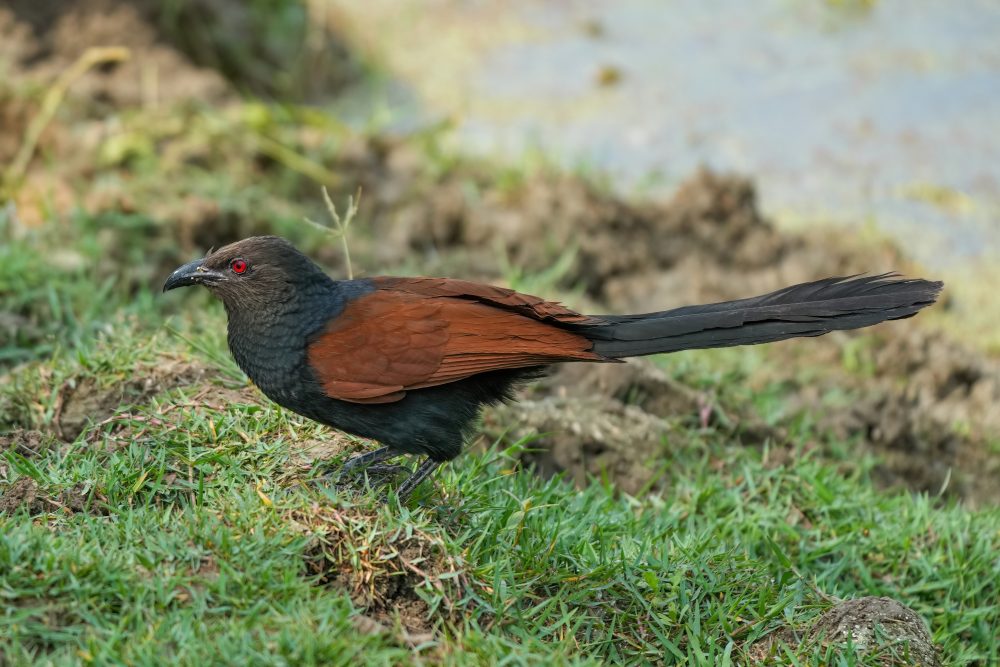
oop-oop-oop-oop, deep and even
Recorded in Thailand, on Phuket. A low, hollow series of “oop”s on one note, like blowing into a bottle - unlike the koel, which always rises. A large black bird with chestnut wings that flies reluctantly and clambers through bushes instead.
Photo: Giles Laurent, CC BY-SA 4.0
This recording was made in Thailand, on Phuket. People constantly confuse the coucal with the koel, although it is easy to tell them apart: the koel always rises in pitch, while the coucal gives an even series of hollow “oop”s on one note, as if blowing into a bottle. It is a large bird, black with chestnut wings, that flies reluctantly and prefers to clamber through bushes.
Coppersmith barbet - a metronome in a tree
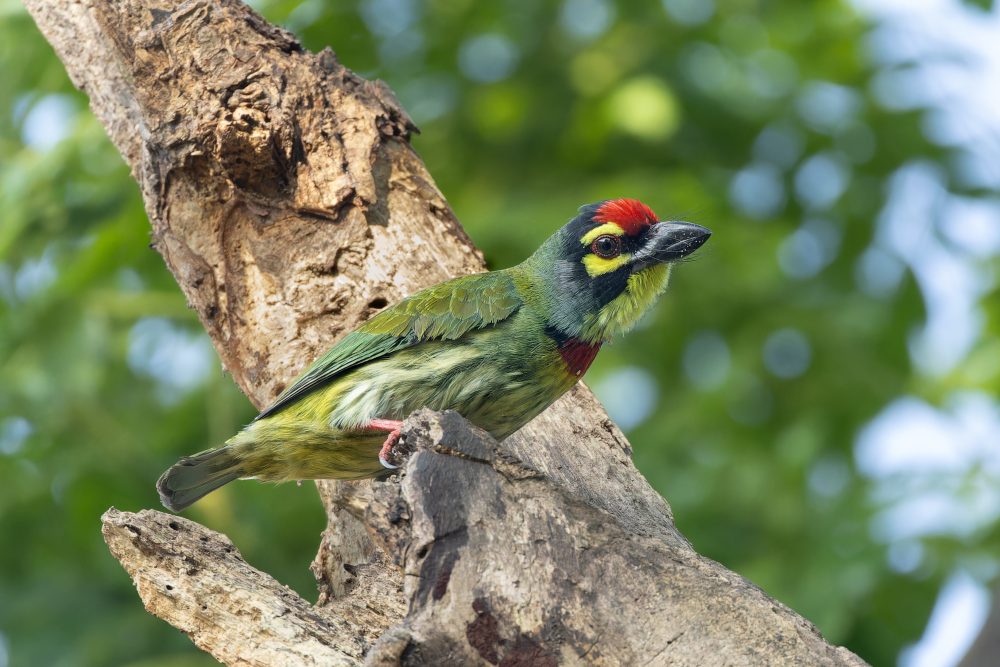
tuk… tuk… tuk… tuk - like a metronome
The Thai name means “the bird that beats gold”, the English one is “coppersmith”. Even knocks once a second, dozens in a row, with no expression at all. People look around for a building site or a dripping air conditioner - and it is a green bird the size of a sparrow.
Photo: Tisha Mukherjee, CC BY-SA 4.0
Even knocks once a second, dozens in a row, with no expression whatsoever. People look around for a building site, a woodpecker or a dripping air conditioner. The culprit is a green bird the size of a sparrow, with a red forehead and a red patch on the breast.
Its names are telling in both languages: in Thai นกตีทอง, “the bird that beats gold”, and in English coppersmith barbet.
Common myna - the boldest bird in town
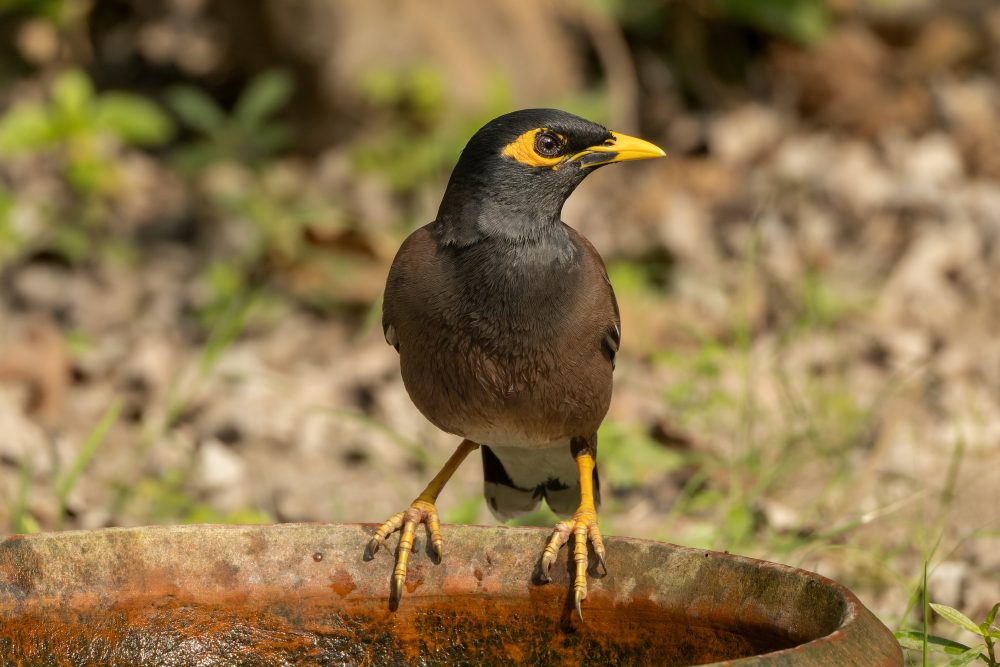
creaks, clicks, chatter, sometimes borrowed sounds
The boldest bird in Pattaya: brown with a yellow bill and yellow skin around the eye, it walks rather than hops. It mimics, so its repertoire can include car alarms and snippets of human speech.
Photo: Tisha Mukherjee, CC BY-SA 4.0
Brown, with a yellow bill and yellow skin around the eye, it walks rather than hops across car parks and food courts. Its repertoire is huge: creaks, clicks, chatter, and it mimics too - car alarms and snippets of human speech turn up in its performance. If a meaningful-sounding screech with intonation comes from the bushes, it is usually a myna.
Oriental magpie-robin - the best singer on the list
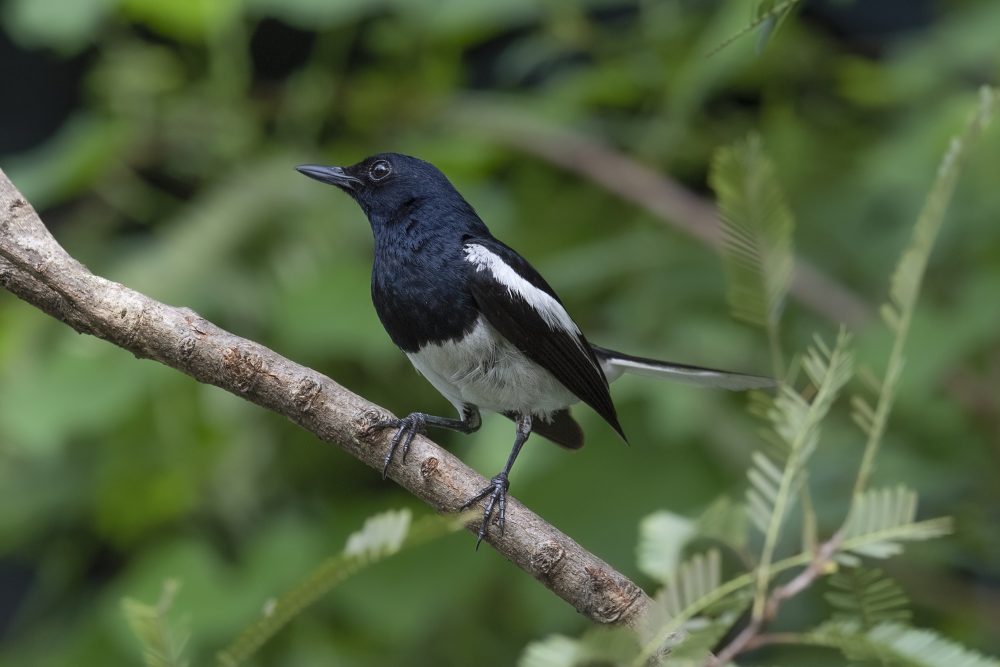
a long, varied song, different every time
The most beautiful song on this list: real melodic phrases that hardly ever repeat. A black-and-white bird the size of a sparrow that holds its tail cocked. Because of its voice it is widely trapped for sale, so it is becoming rarer in towns.
Photo: Anjan Kumar Kundu, CC BY-SA 4.0
The only one in this selection you might want to listen to just for pleasure. Real melodic phrases that hardly ever repeat. A black-and-white bird the size of a sparrow that holds its tail cocked.
The beautiful voice has a sad side: it is exactly why magpie-robins are widely trapped for sale, and why they are becoming rarer in towns. On xeno-canto, the largest archive of bird sound recordings, recordings of this species are restricted from download - precisely so that trappers cannot use them as lures.
Red-whiskered bulbul and black-naped oriole
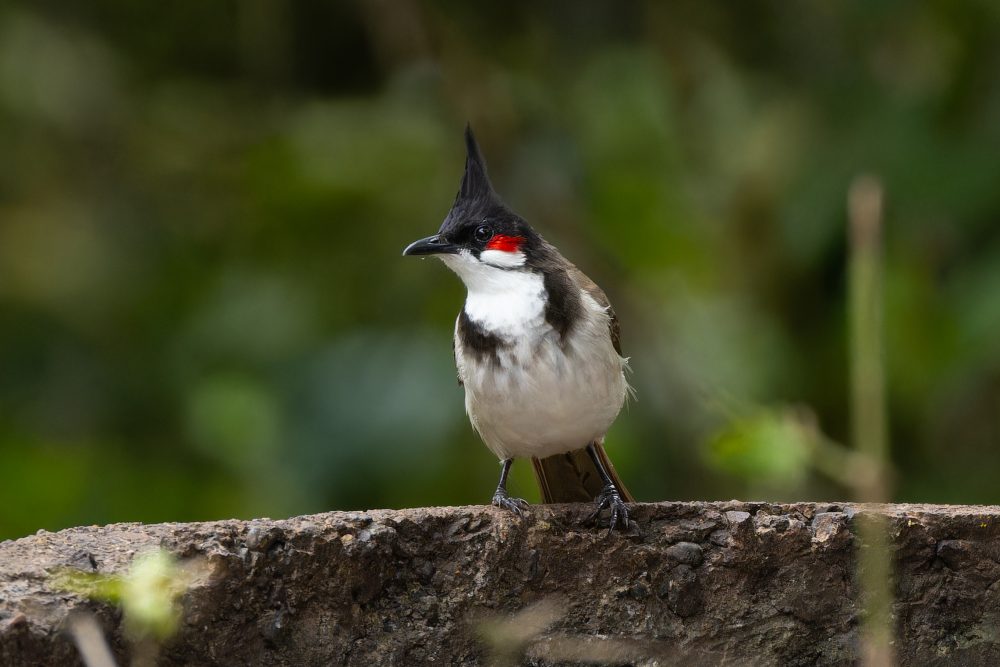
a cheerful “pree-vee-veet!” in short phrases
A pointed crest, a red patch on the cheek, white “trousers” under the tail. Sings short cheerful phrases of 3-5 notes - it neither draws them out like the magpie-robin nor knocks like the barbet.
Photo: Tisha Mukherjee, CC BY-SA 4.0
A pointed crest, a red patch on the cheek, white “trousers” under the tail. It sings short cheerful phrases of three to five notes: it neither draws them out like the magpie-robin nor knocks like the barbet.
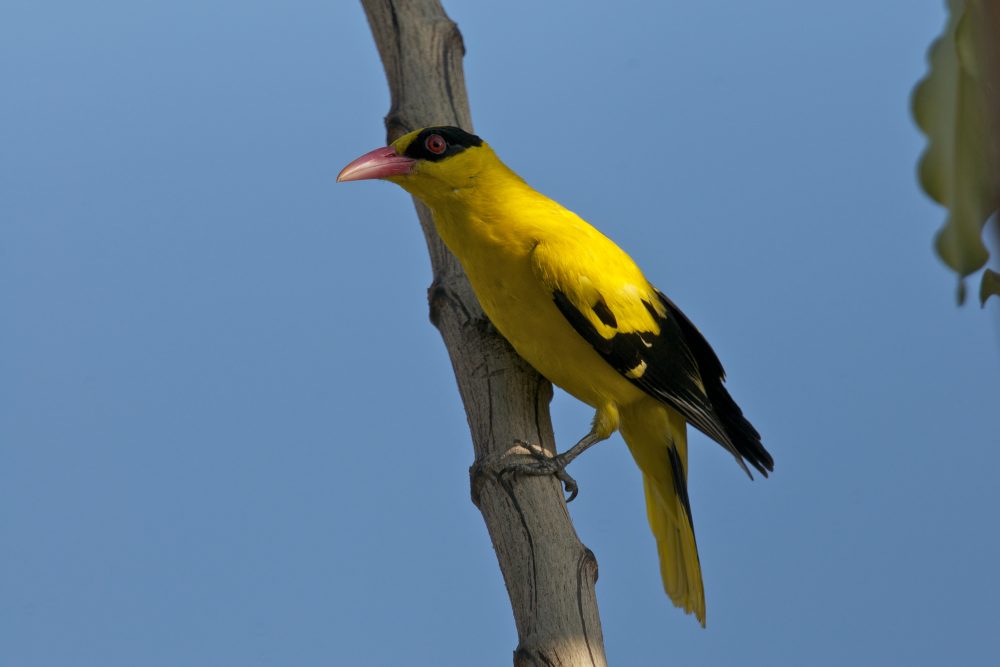
a fluting “tyoo-leeoo” with a slide
A bright yellow bird with a black mask, fairly large but hidden in the foliage - usually heard, not seen. A clean sound like a whistle into a flute, just two syllables with a sliding drop.
This is the male. The female is duller, greenish-yellow.
Photo: Peter Gronemann, CC BY 2.0
Bright yellow, with a black mask through the eye, fairly large - but it sits in dense foliage, so it is almost always heard and almost never seen. A clean sound, like a whistle into a flute, in two syllables with a sliding drop.
Spotted dove - background noise you stop noticing
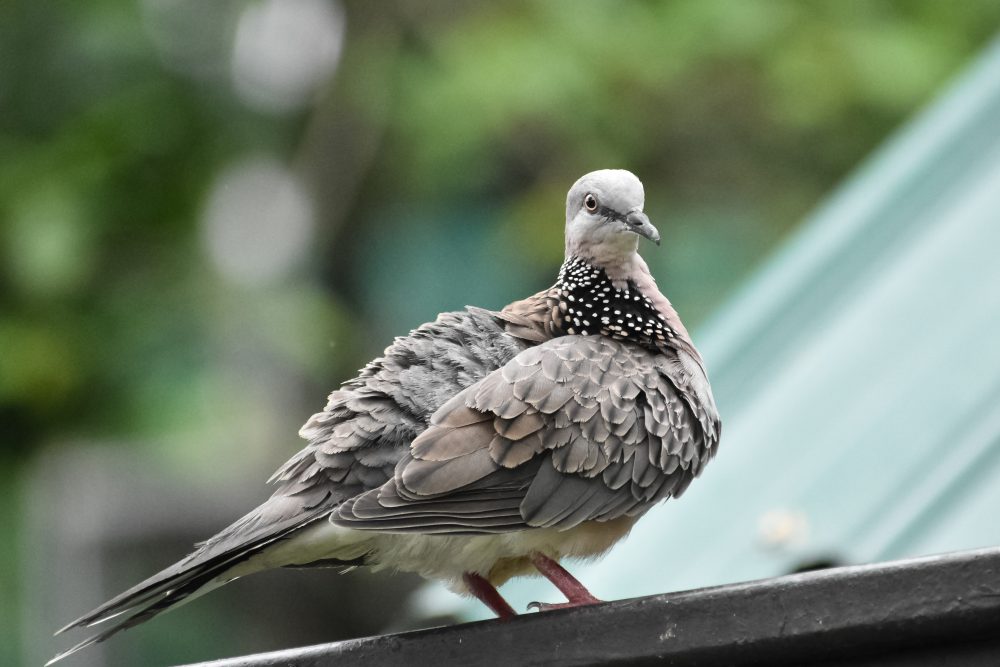
coo-currr-cooo, soft, in three syllables
The background cooing you hear constantly and stop noticing after a week. Instead of a collar it has a black patch dotted with white on the neck. It sits close and is hardly afraid of people.
Photo: GerifalteDelSabana, CC BY-SA 4.0
It coos all day long from a wire, a parapet or an air-conditioning unit. After a week in Pattaya you no longer hear it. Instead of a collar it has a black patch dotted with white on the neck, hence the name. It is hardly afraid of people and lets you come within two steps.
Cicadas: why it sounds like a transformer is humming nearby
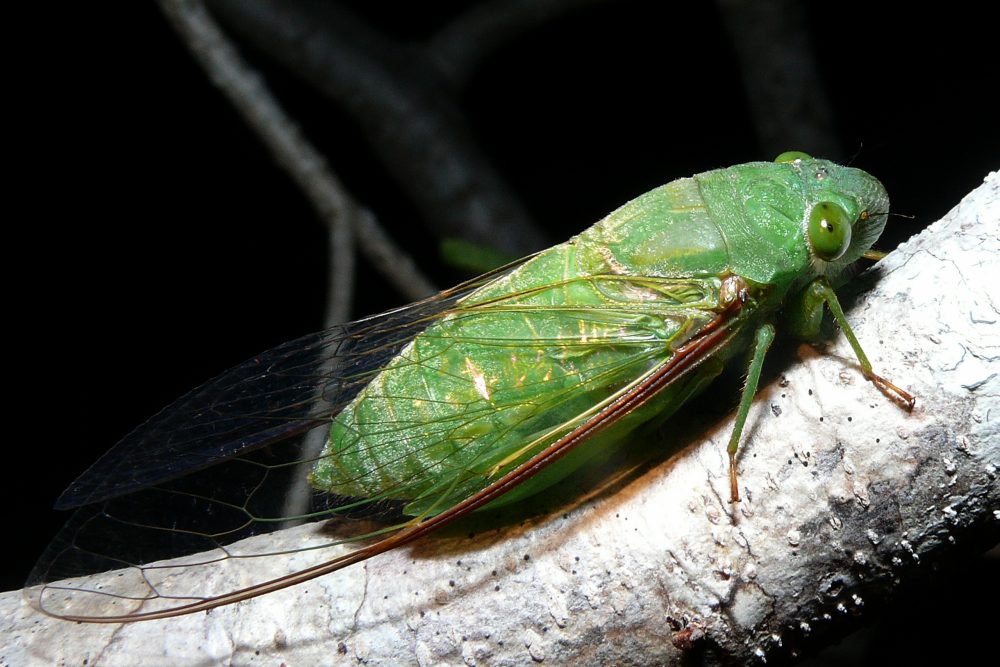
zzzzzz-ZZZZ-zzzzz
Not a single insect but a chorus that switches on and off in waves. At its peak it reaches about 90 dB - roughly a jackhammer a metre away. Many newcomers think a transformer is humming somewhere.
The photo shows Dundubia vaginata - a genus also common in Thailand. There are dozens of cicada species here and they look different.
Photo: Bernard DUPONT, CC BY-SA 2.0
This is not one insect but a chorus that switches on and off in waves. In the hot season, from March to May, cicadas reach their peak and are so loud that you have to raise your voice in conversation: measurements of some species reach around 90 decibels - the level of a jackhammer a metre away.
The rule of thumb is simple: if the hum comes from the trees, builds towards sunset and moves in waves, it is cicadas. If it is even, without waves, and comes from a concrete box by the wall, it really is a transformer.
Jungle sounds: gibbons, hornbills and a laughing flock
The three recordings below were made in Thai national parks - Khao Yai, about four hours from Pattaya. These voices are not heard in the city itself, and that is useful to know: if you hear a gibbon in Pattaya, you are standing next to someone’s cage, not in a forest.
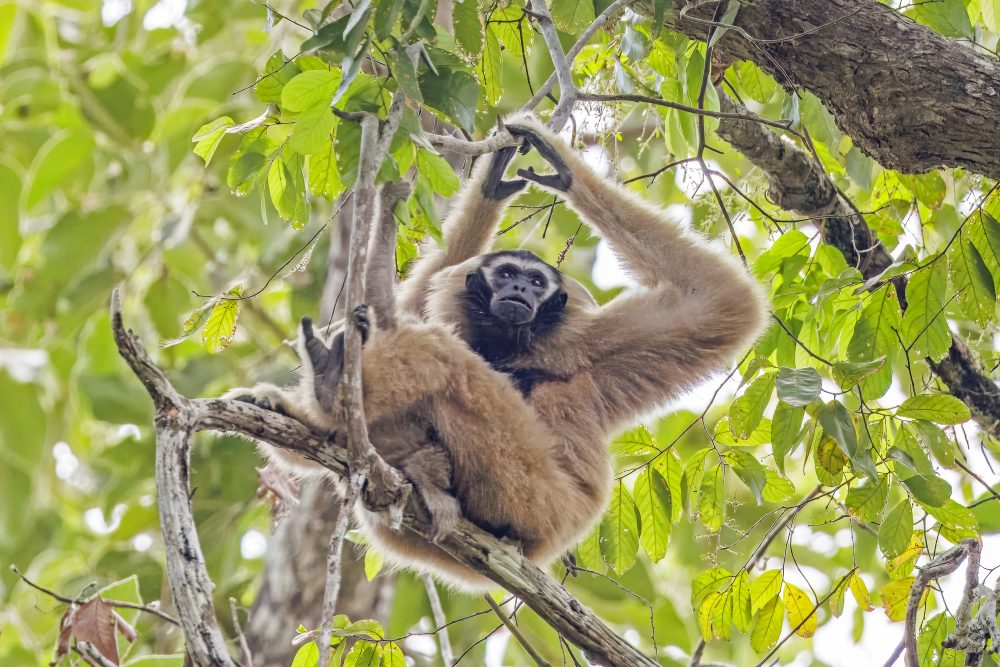
an accelerating “oo-oo-oo-oo-WHEE”, in chorus
A pair sings a duet: the female gives an accelerating series and the male howls along. It carries for kilometres and sounds so unlike a monkey that people take it for a bird or a person. If you hear this in Pattaya, you are near someone's cage, not in the forest.
This is a female, which is pale. The male is almost entirely black.
Photo: Charles J. Sharp, CC BY-SA 4.0
A pair sings a duet: the female gives an accelerating series and the male howls along. It carries for kilometres, and the sound is so unlike a monkey that people take it for a bird or a person.
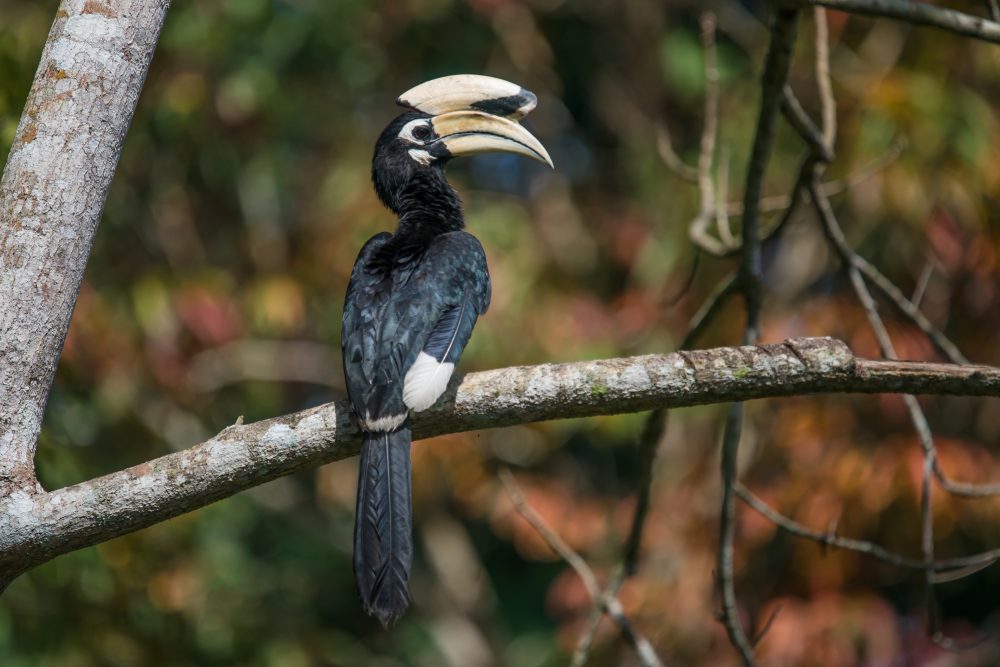
a harsh, barking “kek-kek-kek”
The Thai name is again the sound itself. Besides its voice it gives itself away by the noise of its wings: you hear it from far off, as if someone were flapping heavy cloth overhead.
Photographed in Thailand, Kaeng Krachan.
Photo: Rushen, CC BY-SA 2.0
The Thai name นกแก๊ก (nok kaek) is again onomatopoeia. Besides its voice, the hornbill gives itself away by the noise of its wings: you hear it from far off, as if someone were flapping heavy cloth overhead.
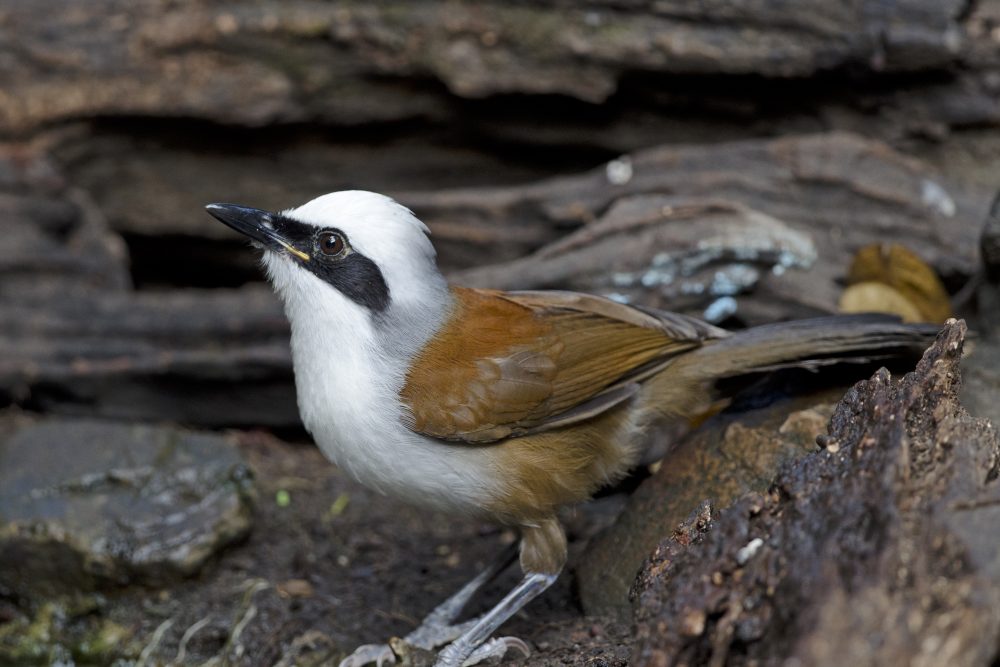
an outburst of laughter in several voices
The name says it all. A flock suddenly bursts into hysterical laughter all together for about ten seconds, then stops just as abruptly. On a forest trail it makes quite an impression.
Photographed in Thailand, Kaeng Krachan.
Photo: Jason Thompson, CC BY 2.0
The English name says it all. The flock suddenly bursts into hysterical laughter in several voices for about ten seconds, then stops just as abruptly. On a forest trail it makes quite an impression.
Which Thai animals are worth worrying about, and which are just loud
What follows is the second, practical part. Here I stick only to facts I found in official documents: the Thai Ministry of Public Health clinical guideline on venomous snakebite (2025 edition, B.E. 2568), the CDC Yellow Book and WHO materials. Where there is no official data, I say so.
The general principle worth learning before anything else: what is dangerous in Thailand is almost always silent. Everything that calls loudly on this list is harmless to you. Snakes, centipedes and jellyfish make no sound at all - which is exactly why safety here comes not from your ears but from a torch, proper shoes and the habit of not putting your hands where you cannot see.
What you do not need to treat as a threat
| Who | Actual risk |
|---|---|
| Tokay gecko | None. Only dangerous if you grab it: strong grip, painful bite that can break the skin |
| House geckos (jing-jok) | None. They eat mosquitoes - useful housemates |
| Water monitor (up to 2 m) | People are not on its menu and it does not attack on its own. If provoked - lacerations and bacterial infection, but no venom |
| Bat in flight | Not while flying. Only a bat you pick up is a risk: bats are among the carriers of rabies |
| Millipede | None. It eats plants and has no venomous fangs |
You can tell a harmless millipede from a dangerous centipede by sight, and it is worth remembering:
- Millipede: two pairs of legs per body segment, rounded body, moves slowly, and when threatened curls into a coil and freezes. Safe.
- Centipede: one pair of legs per segment, flat body, moves very fast, visible “pincers” near the head. It will not curl up - it will run away or turn towards you. Do not touch.
Snakes: what the official statistics say
According to the Bureau of Epidemiology of the Department of Disease Control, in 2019 Thailand recorded 4,991 cases of venomous snakebite - 7.51 cases per 100,000 people. According to the National Health Security Office for fiscal years 2020-2023, there were 45,257 bites by venomous snakes and other venomous animals, an average of 11,314 a year, and 117 deaths over the four years combined.
In other words, bites are common, but death from a bite in Thailand is rare. The figure of “about thirty deaths a year” that circulates on blogs is not something I found in official sources, so I will not quote it.
What matters more for Pattaya:
- Chonburi is not among the ten provinces with the highest incidence. The leaders are Trang (56.91 per 100,000), Yala, Chai Nat, Ratchaburi and Nakhon Nayok. By region the South is worst at 17.62, the Central region 7.53.
- There is a clear seasonal pattern. Cases rise towards the end of the hot season, peak in June (12% of the annual total), followed by May and September. January is the lowest.
- Species the Ministry of Public Health lists for the Eastern region (which includes Chonburi): the Siamese Russell’s viper Daboia siamensis and the Malayan pit viper Calloselasma rhodostoma. The monocled cobra Naja kaouthia and the banded krait Bungarus fasciatus occur nationwide. The Malayan krait is not in the official list for the East - it is assigned to the North and Northeast, so I could not confirm the common claim that it lives in Pattaya.
- The reticulated python, occasionally pulled out of city canals, is not venomous.
What to do after a snakebite, and what not to do
This follows the Thai Ministry of Public Health guideline, section on pre-hospital care. The list of what not to do matters more than the list of what to do, because almost all folk remedies cause harm.
Do:
- Lay the person down and keep them calm and still - this slows the spread of venom.
- Immobilise the bitten limb with an elastic bandage wrapped moderately firmly. For a bite on the leg, bandage from the foot to the thigh and apply a splint.
- Get to a hospital as fast as possible. Take the snake along only if it does not delay leaving.
Do not:
- Apply a tourniquet or tie off the limb - the guideline explicitly advises against it. Harm from a tourniquet appears within 20 minutes.
- Cut the wound or suck out the venom. According to systematic reviews, suction removes less than 0.04% of the venom and adds infection.
- Massage the bite or apply herbal poultices.
- Pop blisters.
Antivenom in Thailand is produced by a single institute - the Queen Saovabha Memorial Institute of the Thai Red Cross, founded in 1923. It is the second snake farm in the world and the first in Asia, and according to the Ministry its output covers the country’s domestic needs.
The Ministry guideline gives an indicative list of hospitals in Chonburi that stock antivenom: Chonburi Hospital, Ban Bueng, Bang Pakong, Phanat Nikhom and Queen Savang Vadhana Memorial Hospital in Sriracha. Private clinics in Pattaya are not named in that list - I have not checked whether they stock antivenom, and it is worth finding out in advance rather than at the moment of a bite. The 1330 hotline can tell you where the nearest stock is.
If a snake gets into the house - call 199
199 is the fire and rescue service, and catching snakes is part of its job. Bangkok gives a sense of scale: the service goes out to a snake call on average every fifteen minutes and removes around sixty thousand snakes a year, with a success rate above 90%. Captured snakes are handed over to the Department of National Parks.
The number is national, so the same one works in Pattaya. I did not find publications specifically about snake call-outs in Pattaya, but there is no separate number for them.
Snakes themselves give almost no audible warning. A cobra under threat raises the front of its body, spreads its hood and hisses - but the hiss means “I already see you, back off”, not an advance warning. Your ears will not help here.
Centipedes, scorpions, jellyfish, monkeys
Centipedes. A bite causes immediate burning pain, then swelling and redness. It usually passes within a few days to a week, but cases of pain lasting up to three weeks are described. There is no specific antivenom; treatment is pain relief, wound care and watching for signs of infection. Fatal cases are described in the literature, but they are isolated case reports.
Scorpions. The main large genus in Thailand is Heterometrus. According to review literature, symptoms after stings by this family are mild, and no human deaths are known. There is no scorpion antivenom on the Thai list of antidotes either - it is simply not needed.
Jellyfish. Box jellyfish of the genus Chironex do occur in the Gulf of Thailand, and this is the only item on the list involving real deaths. All documented deaths in the Gulf happened in their habitat zones - above all on Koh Samui and Koh Phangan. Sightings peak from July to September. There are no confirmed fatal cases in Pattaya, although warnings have been issued for Jomtien.
What to do after contact: get the person out of the water, do not rub the affected area, call 1669, and start CPR if breathing stops. The vinegar on Thai beaches is there for exactly this and remains the local standard, but to be fair, there is no single scientific consensus on vinegar - some studies show it can trigger the release of venom from stinging cells still on the skin.
Monkeys. The CDC explicitly advises not to approach, touch or feed macaques: the risk is not only rabies but also herpes B virus, for which untreated infection in humans is fatal in about 80% of cases. At the same time, despite regular bites and scratches from macaques across the country, not a single human case of herpes B infection has been recorded in Thailand.
If a macaque bites or scratches you: wash with soap under running water for at least twenty minutes, thoroughly, scrubbing, and go straight to a doctor. This is not overcaution - it is the CDC’s recommendation.
I found no documented macaque colonies in Pattaya itself. The nearest one described in scientific literature is on Khao Sam Muk in Bang Saen, about forty kilometres away.
Rabies and mosquitoes
Rabies. Large government vaccination campaigns for dogs and cats have greatly reduced its prevalence, but a small risk remains. Dogs are the main carrier, accounting for around 99% of transmissions to humans. The good news: according to the CDC, rabies vaccine and rabies immunoglobulin are available in all provincial and most district hospitals in Thailand. For Chonburi, the provincial hospital is Chonburi Hospital. I could not confirm the annual number of human cases from an official source, so I do not quote a figure.
Dengue. Endemic throughout the country, with large outbreaks every few years; transmission peaks in the rainy season, but cases occur year-round. According to WHO weekly data, levels in 2026 are noticeably lower than last year. There is no “just in case” shot for it here - repellents, screens and no standing water on your balcony are what work.
Malaria. Not relevant for Pattaya. Thailand’s endemic zones are rural forested areas along the borders with Myanmar and Cambodia and the provinces of the far south; for travel elsewhere, including major cities and resorts, the CDC recommends mosquito protection only, with no preventive medication.
Numbers worth keeping in your phone
| Number | Who answers |
|---|---|
| 191 | Police, general emergency |
| 1669 | Ambulance, free of charge |
| 1155 | Tourist Police, 24/7, English-speaking operators available |
| 199 | Fire and rescue - including a snake or monitor lizard in the house |
| 1330 | National Health Security Office: where to find the nearest antivenom |
Thailand has no single 112 number. The working trio is 191, 1669 and 1155.
When the night is loud: homes next to forest and fields
The calm night from the start of this article is the usual picture for a condo in town or by the sea. But in houses that stand right next to forest, fields, canals or ponds, especially in the rainy season, the night can be quite different: rain, frogs, crickets and unfamiliar calls all at once and very loud.
It sounds alarming, but there is nothing dangerous in this chorus - it is the same geckos, frogs and insects from the cards above, just all together. If quiet nights matter to you, keep this in mind when choosing where to live: a green plot next to the jungle is two different places by day and by night.
rain + crickets + frogs + unfamiliar calls
Everything at once and loud: this is what you get in homes right next to forest, fields or ponds. It sounds alarming, but nothing in this chorus is dangerous.
What to make of all this
A short summary, if you had no time to read.
The night call that woke you up is a gecko, and it is harmless. The bird that keeps you awake from five in the morning is the Asian koel, and you can only accept it or fit better windows. The mooing after rain is a frog and will be gone within a day. The hum from the trees is cicadas, peaking in April.
And everything that is genuinely worth being careful about, you will not hear. So three habits are worth more than any list: watch where you step with a torch, do not walk through grass in flip-flops after dark, and do not reach into places you cannot see. That is enough to remember the second half of this article only out of curiosity.
If you are reading this while choosing where to move, we have a guide to Pattaya areas with notes on which are quieter, and a catalogue of places with beaches, schools and markets. We did not include noise in the statistics, but areas next to parks objectively have more cicadas.
More articles